


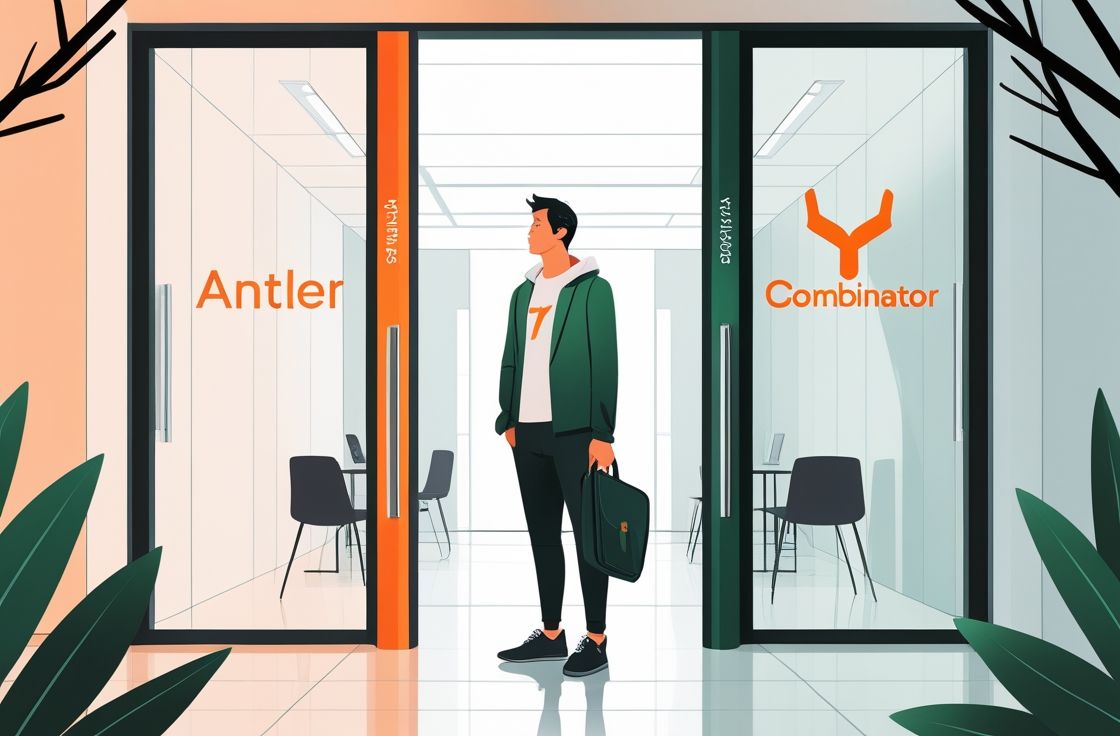
You can apply to Antler with nothing but a resume and a hunch: no idea, no cofounder, not even a direction yet. Antler's whole model is built to help you find that cofounder and shape the idea once you're in the room.
Try showing up to Y Combinator that way and you won't get past the first read. That single difference, whether a program builds your company with you from zero or accelerates one you've already started, is the real decision point here, not the funding amount or the brand name.
This guide breaks down the current 2026 terms, how each program actually evaluates applicants, and which stage each one is genuinely built for.
Antler vs Y Combinator: Quick Comparison
| Feature | Antler | Y Combinator |
|---|---|---|
| Funding | Varies sharply by region: $150K–$400K in Singapore, $500K–$1M in the US, €500K in the Nordics | $500K total: $125K for 7% + $375K uncapped MFN SAFE |
| Equity Structure | Single-digit to low double-digit equity, terms differ by country and change with each new fund | Fixed 7% for the initial tranche, standardized across every batch |
| Program Length | 6–10 weeks in most markets, moving toward a continuous, always-on model in some regions | 3 months |
| Stage Focus | Pre-idea, pre-team, day zero, includes cofounder matching | Existing product, early users or traction |
| Investment Decision | Made at the end of the residency, after an investment committee review; only 20–45% of a cohort typically gets funded | Made at acceptance, before the program starts |
| Global Reach | 27–30+ locations across six continents | Primarily Mountain View, remote-friendly |
| Companies Backed | 1,600+ globally | 5,000+ |
| Notable Alumni | Airalo, Lovable, Wrtn | Airbnb, Stripe, Reddit, Dropbox |
1. Investment Terms and Equity
Antler does not have one fixed deal the way Y Combinator does. Terms vary by country, change as the fund raises new vehicles, and shift year over year, so any specific number should be confirmed directly with the local Antler team before applying.
What's currently true across regions:
- Singapore: updated terms as of January 2026 give founders access to up to $400,000 from inception, with $150,000 as the initial net funding ticket, inside a compact 6-week residency
- United States: an initial commitment of $500,000 to $1M for companies that clear the investment committee, plus roughly $650,000 in partner credits
- Nordics: €500,000 through a continuous, always-on residency, with investment decisions made in as little as four weeks, replacing fixed cohorts entirely
- Melbourne and several other markets: a $260,000 check inside a 10-week program
Antler charges no fee to join a residency. If the investment committee decides not to invest in your team, you keep 100% of your equity and are free to raise from anyone else. Historically, only 20–45% of founders in a given cohort actually receive investment at the end.
Y Combinator's deal, by contrast, is fixed and identical for every company: $125,000 for a fixed 7% equity stake through a post-money SAFE, plus $375,000 through an uncapped SAFE with a Most Favored Nation clause that converts at your next priced round's terms. This deal has been unchanged since January 2022.
In short: YC gives you a bigger, standardized check the moment you're accepted. Antler enters earlier, often before there's a company to invest in at all, and decides on funding only after weeks of hands-on team formation and validation.
2. Acceptance Rate and Application Process
Y Combinator receives more than 25,000 applications per batch and admits roughly 250 companies, an acceptance rate near 1%. The evaluation centers on traction, technical capacity, and how clearly a team can articulate why now, why this market, why this specific team.
Antler has not published one official acceptance rate that applies uniformly across all 27-plus locations, because admission works differently. Applicants first join a residency cohort, and the actual investment decision happens later, after weeks of coaching, team formation, and milestone development, when only a fraction of each cohort clears the investment committee.
Antler explicitly backs founders at day zero. You can apply without a cofounder, without a validated idea, and without a product. Y Combinator expects the opposite:
- An existing team, or at minimum a strong, high-conviction solo founder with a clear direction
- A product in some form, not just a concept
- Ideally early users or revenue signaling real velocity
Solo, pre-idea applicants are a poor fit for YC's evaluation process. That same profile is exactly who Antler's residency is designed for.
3. Mentorship and Program Philosophy
Antler's residency is built around hands-on, structured development during the earliest phase of company building:
- Cofounder matching for solo applicants without a team yet
- Weekly coaching sessions
- Milestone-driven check-ins
- A formal investment committee review at the end
Founders work closely with Antler staff and local operators throughout, not just at the edges.
Y Combinator provides access rather than structure:
- Weekly partner office hours
- The internal Bookface platform
- Guidance from veteran operators, but no formal roadmap
YC expects founders to move fast independently and ask for specific help when they need it, rather than following a coached, sequential process.
Not Ready for the Accelerator Path?
Most founders apply to an accelerator before the underlying product or team can actually make use of the program. If you're still shaping your MVP, validating demand, or figuring out your go-to-market, Ellenox helps build that foundation first, so an accelerator application reflects real signal instead of hope.
4. Alumni Outcomes and Growth Trajectories
| Metric | Antler | Y Combinator |
|---|---|---|
| Companies Backed | 1,600+ | 5,000+ |
| Notable Outcomes | Lovable (AI unicorn), Airalo (20M+ users), Wrtn ($73.5M Series B) | Airbnb, Stripe, Dropbox, Reddit, Instacart |
| Unicorns | Emerging, several now reaching that scale | 90+ |
| Combined Valuation | Not centrally disclosed; grown substantially since early cohorts | $600B+ |
Antler's portfolio has matured meaningfully since its earlier years: Lovable, one of its backed companies, has reached global AI unicorn status, and the firm has scaled from roughly 800 companies backed to over 1,600 in a relatively short window. YC's track record spans two decades and includes some of the most valuable technology companies ever built, giving it a longer, deeper base of proof points.
5. Global Reach and Specialization
Antler operates in 27 to 30-plus cities across six continents, with region-specific programs and, increasingly, thematic tracks. This geographic depth is a real advantage for founders building something tied to a specific local market or regulatory environment, since Antler's local teams bring context YC's more centralized model doesn't replicate. Antler Embark, a GTM-led initiative, specifically helps Antler-backed startups expand from Southeast Asia into the US market post-investment.
Y Combinator remains centered on Mountain View, California, with remote-friendly batches available since 2020. Its network gravity sits heavily in Silicon Valley's investor base, which matters most for founders targeting US-first fundraising and distribution.
6. Application Strategy and Tips
For Antler, the strongest applications demonstrate:
- Clear thinking about a problem space, even without a finished product
- Evidence of resilience and execution ability from prior work, even outside startups
- Genuine openness about your current stage, including if you're still looking for a cofounder
Antler's investment committees are explicitly evaluating whether you're a founder worth betting on before there's anything else to evaluate.
For Y Combinator, applications succeed on:
- A tight answer to why this team, why this market, why now
- Real traction or technical depth backing that answer
- A 60-second video that communicates founder conviction clearly, which matters more than production polish
7. Demo Day and Post-Program Support
Antler's outcome events are typically local or regional pitch sessions, with follow-on capital available through Antler's own fund structures (including initiatives like Antler Elevate) for teams that continue building. Support after the program varies more by location than YC's model does.
Y Combinator's Demo Day reaches over 1,000 investors in a single event, frequently producing rapid follow-on fundraising in the days immediately after. YC's alumni network and ongoing platform support are more centralized and consistent across every batch, regardless of geography.
You don't need a pitch deck to start working with Ellenox. A real problem and a willingness to build are enough.
9. Final Take: Antler vs YC
Choose Antler if:
- You're still forming your team or refining a raw idea
- You want structured coaching and cofounder matching from day zero
- You're building outside the US and want deep local market context
Choose Y Combinator if:
- You already have a team, a product, and some early momentum
- You thrive in a self-directed environment without a formal roadmap
- You want the broadest possible investor signal and Silicon Valley network access
Ready to Build Something Real?
Most founders apply to accelerators before the team, idea, or product is actually ready to make the most of the program. If you're still forming your cofounder team, validating demand, or shaping your first product, Ellenox works alongside early-stage founders to build that foundation first, so whichever path you choose next, Antler, Y Combinator, or continuing to build independently, you're walking in with real substance instead of a raw idea.