


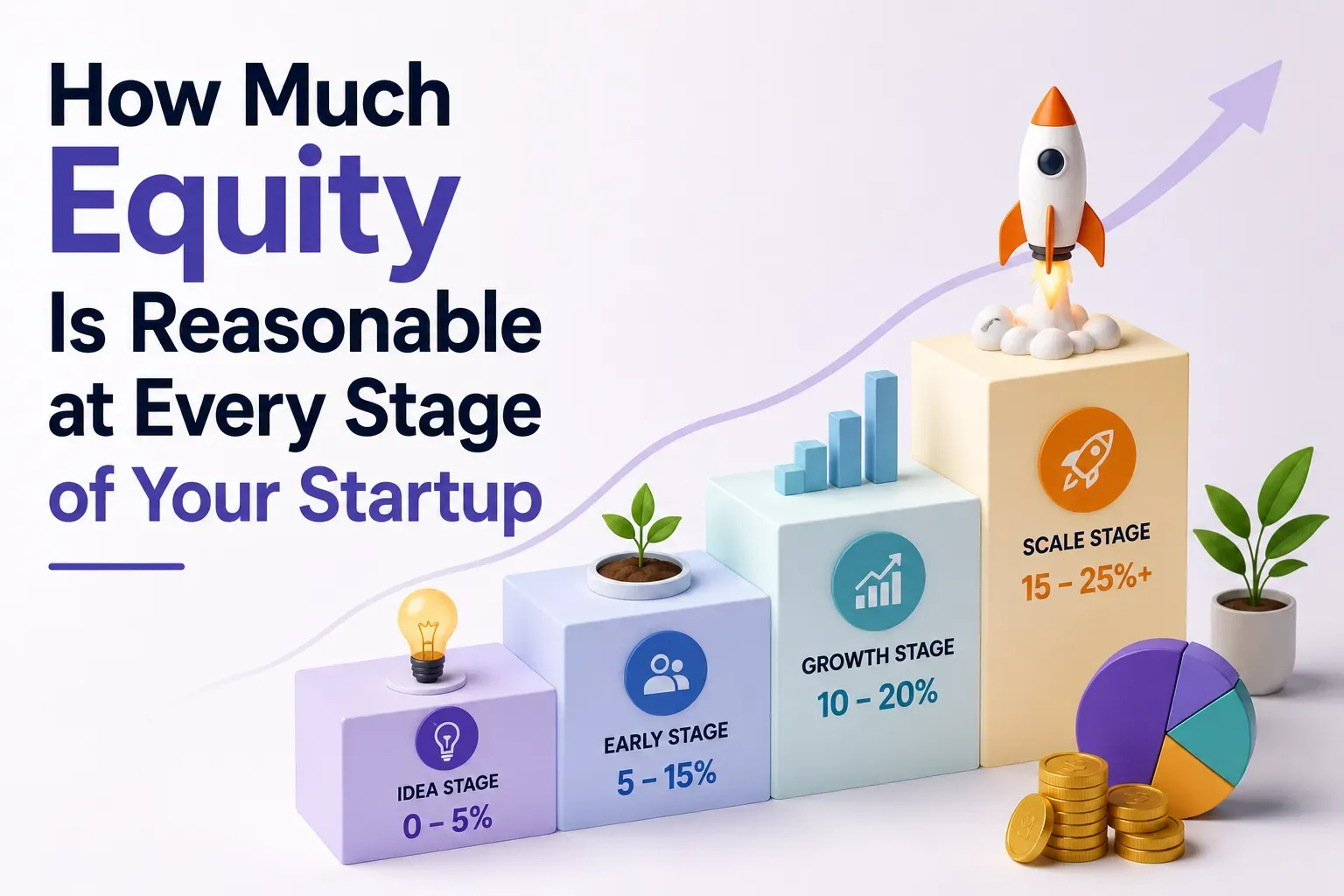
Equity is the resource that's easiest to spend and hardest to recover. Most founders don't realize how much they've given away until they're preparing for a Series A and someone runs the cap table math. By then, the decisions are made. The conversation you needed to have with your co-founder happened in a coffee shop fourteen months ago, with no documentation. The early engineer got 0.5% because that felt fair at the time, and now they're vested and gone, and you can't get it back. The advisor who promised to open doors collected 1% and made one introduction.
This is the article about understanding the numbers before you're in the room. Whether you're splitting equity with a co-founder at 2 AM, making an offer to your first engineer, or sitting across from a term sheet for the first time, the patterns matter. Get the foundational decisions right, and they stay right. Get them wrong, and you spend years correcting them, sometimes unsuccessfully.
No single percentage is "right" for any situation. But there are patterns, and knowing the patterns means you can make deliberate choices instead of defaulting to whatever feels fair in the moment.
Why Equity Shrinks Across Stages (and Why That's Supposed to Happen)
Before getting into the numbers, the framing is what makes the numbers make sense.
Equity is not a static slice of a fixed pie. The pie grows. When you raise money, you're trading ownership percentage for capital that should grow the company's value enough to make your remaining percentage worth more in absolute terms. A 30% stake in a company worth $50M is worth more than a 60% stake in a company worth $10M. The math is supposed to work that way.
What actually shocks founders is the speed of dilution and how it compounds. Carta's 2026 Founder Ownership Report shows that by the time a company raises a seed round, the median founding team retains about 56% of their fully diluted equity. By Series A, that number drops to 36%. Those numbers are not pathological. They're the median. The companies you read about in TechCrunch are following roughly this trajectory.
The other concept that matters before any numbers make sense: fully diluted shares. Your percentage ownership should always be calculated on fully diluted shares, meaning total shares including all outstanding options, warrants, and convertible instruments. Without that denominator, the stake looks higher than it is. A 1% grant on issued shares might be 0.7% fully diluted once the option pool is created. This is the single most common trick in a poorly-explained offer letter, and the question every offer recipient should ask first.
The Co-Founder Split
The first equity decision most founders make is also the one they spend the least time on. Equal splits are more common than they should be, mostly because 50/50 feels fair and avoids the conversation that would force you to clarify what each founder is actually bringing.
The factors that matter for a real co-founder split:
- Who is going full-time, and from when (part-time founders tend to over-rate their contribution and under-rate the risk full-time founders are taking)
- Who is taking the bigger financial risk (leaving a stable job, declining other offers, supporting a family without a salary)
- Whose skills are most critical in the first 12 months and over the long run
- Who is putting in cash, and whether that should be treated as an investment or as an equity-eligible contribution (almost always investment)
The structural point that matters more than the exact percentages: the vesting schedule. A 60/40 split with no vesting is more dangerous than a 50/50 split with four-year vesting and a one-year cliff. The vesting is the protection. Without it, the founder who leaves after fourteen months walks away with their full original stake, and the team that stays spends years resenting it.
This piece doesn't dive deep into the co-founder split itself because we wrote a complete guide on it. The short version: have the uncomfortable conversation explicitly, don't default to 50/50 because it feels safer, and document the agreement before there's anything material to fight over.
The Option Pool: Why You Need It Before Your First Term Sheet
Before you hire anyone, you need a place to grant equity from. This is the employee stock option pool, and creating it before your first term sheet arrives is one of the most important defensive moves available to founders.
The mechanic that catches first-time founders: Most early-stage term sheets push the option pool into the pre-money valuation. This means the founders dilute themselves to fund the pool before the investor's money hits the bank. The investor's stated stake stays the same. The founders' stake shrinks. This is called the option pool shuffle, and at seed, where pools are typically 10 to 15% of fully diluted shares, the cost to founders can be five to seven points of additional dilution they didn't fully understand they were signing.
The fix: Create a 10 to 15% option pool at incorporation. Allocate from it deliberately as you hire. When you raise your first priced round, the pool exists, and the investor's negotiation is about top-ups (typically pushing the pool back to 10 to 15% post-grant), not about creating the pool from scratch in pre-money.
Over 70% of equity financings include an option pool top-up. That's the normal pattern. What's not normal, and what you want to avoid, is negotiating the size and timing of the initial pool during a term sheet conversation when the power dynamics already favor the investor.
Equity for Early Employees: What's Fair in 2026
The most concrete section, with the most useful numbers.
Pear VC, one of the most-referenced sources for early-hire equity benchmarks, updated its framework in March 2026 to reflect the intensified competition from AI companies for early-career engineers. They moved the baseline grant for the first hire from 0.75% to 1%, reduced the per-hire discount from 20% to 10%, and narrowed the junior/senior gap. The numbers below reflect those updated benchmarks alongside data from Carta and the still-referenced Holloway / Babak Nivi tables.
| Stage | Role | Equity range (fully diluted) |
|---|---|---|
| Pre-seed / Seed (employees 1-3) | Senior engineering/founding engineer | 1.0% to 2.0% |
| Pre-seed / Seed (employees 1-3) | Mid-level engineering/product | 0.5% to 1.0% |
| Seed / Series A (employees 4-10) | Senior IC | 0.3% to 0.75% |
| Seed / Series A (employees 4-10) | Mid-level IC | 0.1% to 0.4% |
| Series A / Series B (employees 10-50) | VP / C-suite | 0.5% to 2.0% |
| Series A / Series B (employees 10-50) | Director / Senior IC | 0.25% to 1.0% |
| Series A / Series B (employees 10-50) | Manager / mid-level | 0.15% to 0.5% |
| Series A / Series B (employees 10-50) | Junior IC | 0.05% to 0.25% |
| Post-Series B | New hire grants (any role) | Typically 30-50% lower than pre-Series B equivalents |
| Post-Series B | Refresher grants | 0.05% to 0.15% annual |
The underlying principle: The first few people who join your company are taking an enormous risk. They're probably leaving a safer job. They're betting months or years of their career on something that statistically won't work. The equity should reflect that risk, not just their title. Employee #2 at a pre-seed company is not the same person as Employee #2 at a Series B company, and the equity grant should not be either.
The critical context for anyone receiving an offer: Always confirm the fully diluted share count. Without that denominator, your percentage is incomparable to anything. A 1% grant on a 10-million-share company is very different from 1% on a 100-million-share company once option pool top-ups and future dilution are factored in. Any offer that won't give you the fully diluted number is an offer you can't actually evaluate.
Advisor Equity: Don't Over-Advise in the First Year
Most first-time founders give away too much advisor equity in their first twelve months. Advisors feel like progress. Formal advisor relationships feel like validation. But every 0.25% you give away has a future cost, and an advisor who isn't genuinely useful is an expensive introduction.
Advisor equity benchmarks from Carta, Pulley, and AngelList data through 2026:
| Advisor type | Equity range | Vesting | Typical commitment |
|---|---|---|---|
| Strategic advisor (occasional input) | 0.1% to 0.25% | 2 years, 3-month cliff | Monthly call, occasional intros |
| Active advisor (regular involvement) | 0.25% to 0.5% | 2 years, 3-month cliff | Bi-weekly meetings, intro pipeline, fundraising help |
| Board-level strategic advisor | 0.5% to 1.0% | 2 years, 3-month cliff | Sustained involvement, named in pitch deck, hands-on during inflection points |
The FAST (Founder/Advisor Standard Template) agreement, created by the Founder Institute, is the market standard. Use it as a starting point, modify the equity and commitment levels to fit the relationship, and have your lawyer review it before signing.
The conversation that prevents most advisor disappointments: Before any equity is offered, get explicit about what the advisor will do, how often, and what success looks like at six months. "I want you to be my advisor," without a defined mandate, produces advisors who collect equity and never quite do anything specific. "I want you to make three warm introductions to enterprise CIOs in the next quarter, take a monthly call, and read our fundraising deck before we send it." This produces advisors who either do those things or quietly excuse themselves.
The same conversation goes both ways. If you're being asked to advise a company, ask the founder what they expect. If they can't answer specifically, they're not ready to have you as an advisor yet.
Investor Dilution by Stage: How the Pie Shrinks
The most important thing to understand before your first raise: dilution isn't just what happens in one round. It compounds. A rule of thumb is to assume 10 to 25% dilution per funding round, with the exact number depending on the size of the round, the valuation, and your leverage.
| Stage | Typical investor stake | Check size range | What you give up |
|---|---|---|---|
| Friends and family / pre-seed angels | 5% to 10% | $50K to $250K | Small slice, usually on a SAFE or convertible note |
| Pre-seed institutional | 10% to 15% | $250K to $1M | First meaningful dilution event |
| Seed | 15% to 20% | $1M to $4M | Often a priced round; option pool top-up usually included |
| Series A | 20% to 25% | $5M to $15M | Largest single dilution event; board seats are typically added |
| Series B | 15% to 20% | $15M to $40M+ | Investors now hold real leverage; founder share drops materially |
| Series C and beyond | 10% to 15% per round | $30M+ | Dilution slows as a percentage, but compounds against an already-reduced founder stake |
The Carta data tells the cumulative story: the median founding team retains 56% of fully diluted equity at seed, dropping to 36% at Series A. Both numbers shock founders the first time they encounter them. Neither is unusual.
AI founders in 2026 are retaining noticeably more. CRV's April 2026 analysis shows AI company founders holding 5 to 10 points higher equity at Series A and Series B compared to non-AI peers, reflecting stronger negotiating leverage in a market where investors are competing harder for AI deals. This is real, but it's also cyclical. The general principles still apply.
The nightmare scenario, named directly: An inverted cap table, where investors collectively hold more equity than the founding team, is viewed by most serious later-stage investors as essentially uninvestable without fundamental restructuring. It doesn't happen in one bad decision. It happens through a series of reasonable-at-the-time choices that compound: a too-generous early angel round, an oversized option pool, an aggressive seed dilution because you needed the money fast, a Series A where you didn't push back on valuation. Avoiding this isn't about negotiating hard on one round. It's about being conservative across all of them.
If You're the One Being Offered Equity: How to Evaluate It
A different audience, same information. The person reading this just received an offer letter with an equity grant that they don't know how to value.
Three things to ask for before deciding anything:
The current fully diluted share count and your resulting percentage. If the company won't share this, that's your answer. A founder who respects the offer they're making will share the cap table basics.
The most recent 409A valuation. This is the fair market value of the common shares, set by an independent appraiser. It tells you what your options are worth today on paper.
The preference stack. Liquidation preferences (1x, 2x, participating vs non-participating) determine who gets paid first in an exit and how much. A company with 3x participating preferences across multiple rounds can have an exit where common shareholders get nothing while preferred shareholders get a meaningful return.
Then do the exit math yourself. Take your percentage ownership, multiply it by a range of exit valuations, subtract the cost to exercise your options, and apply rough taxes. At a $100M acquisition, 0.5% is worth $500K before dilution and taxes. At $500M, $2.5M. At zero, zero. The exercise isn't to predict which outcome happens. It's to understand the range so you can decide whether the bet makes sense given your alternatives.
What's negotiable, and when: Almost everything in the offer is negotiable, but the moment of leverage is before you accept. After is rare. Salary, equity grant, vesting schedule, acceleration provisions, exercise window, and even the fully diluted share count can all be discussed. The companies you want to work for will engage with these questions thoughtfully. The companies you don't want to work for will treat them as red flags.
The Numbers Over Time: A Worked Example
A single hypothetical company is traced through five stages. The percentages assume a typical SaaS trajectory, no aggressive dilution, and no inverted cap table. The point is to show how the math compounds.
| Stage | Event | Founder team total | CEO stake | Employee #1 (1% at seed) | Investor cumulative |
|---|---|---|---|---|---|
| Incorporation | Two founders, 50/50 split, 10% option pool reserved | 90% | 45% | N/A | 0% |
| Pre-seed | $750K SAFE, 12% dilution | 79% | 39.6% | N/A | 12% (SAFE not yet converted) |
| Seed | $3M priced round, 18% dilution; option pool topped up; Employee #1 granted 1% post-money | 64% | 32% | 1% | 25% (SAFE converts + new round) |
| Series A | $10M raise, 22% dilution; option pool topped up by 4% | 47% | 23.5% | 0.74% | 39% |
| Series B | $25M raise, 17% dilution; option pool topped up by 2% | 38% | 19.0% | 0.59% | 47% |
| Acquisition at $500M | Common shareholders are paid after 1x non-participating preferences | Founders share ~$185M total before tax | CEO receives ~$92M before tax | Employee #1 receives ~$2.9M before tax | Investors return 5-7x on average |
A few observations from this worked example:
The CEO who started with 45% holds 19% at Series B. That feels like a massive loss until you do the dollar math at exit. Forty-five percent of an acquisition that never happens is worth zero. Nineteen percent of a $500M exit is worth more than most founders' lifetime earning potential in any other career path.
Employee #1 with a 1% grant at seed ends up with 0.59% after three rounds of dilution. The dollar value is meaningful at a successful exit, modest at a small acquisition, and zero in the most likely outcome, which is the company failing or being acquired. The grant should be evaluated against all three scenarios, not just the success case.
Investors collectively hold 47% at Series B, which is below the founder team's 38% only because of preferred shareholder concentration. In a less favorable scenario (more rounds, larger pool top-ups, lower valuations), the founders would already be below the investor stake. That's the inverted cap table risk in numbers.
What to Watch Out For
The things that bite founders and employees, not in the legal disclaimer sense, but in the actual patterns that show up in real startups.
The option pool shuffle: Already named earlier, worth repeating because it's the most common and most preventable. Create the option pool before your first term sheet conversation. Make the investor negotiate the top-up, not the initial creation, because investors will push to put the pool creation in pre-money valuation, and you will lose the dilution percentage you didn't realize you were giving up.
Single-trigger vs double-trigger acceleration: Some option agreements accelerate vesting if the company is acquired (single-trigger). Others require both an acquisition and a termination without cause (double-trigger). A single trigger is rare and very valuable to the option holder. Double-trigger is standard. The difference matters enormously in an acquisition scenario and rarely gets discussed in the initial offer conversation. Ask, and ask before you sign.
The 90-day post-termination exercise window: Standard option agreements give you 90 days after leaving the company to exercise your vested options or lose them. For Incentive Stock Options (ISOs), if the strike price has grown meaningfully and the company is still private, this can mean a six-figure tax bill on shares you can't sell. A small but growing number of companies have moved to 10-year post-termination exercise windows, removing this problem entirely. Ask whether your prospective employer offers this. The answer is increasingly yes for top-tier companies and almost always no by default.
Grant date matters more than percentage: An option grant before a major funding round has a much lower strike price than one after. For a high-growth company, being granted options at a $5M valuation versus a $50M valuation is the difference between a meaningful outcome and a mediocre one, even with the same percentage grant. If you're joining before a round, the grant date matters. Push for it to happen before the round closes if possible.
The "% of issued shares" trick: Some offer letters quote percentage ownership as a share of issued shares, which excludes the unissued options in the pool. This makes your stake look higher than it is on a fully diluted basis. Always recalculate against fully diluted. Always.
Ready to Get the Equity Math Right?
Equity decisions look like financial decisions. They're really commitment decisions, communication decisions, and trust decisions wearing financial clothing. The founder who gives away too much at pre-seed wasn't bad at math. They were uncertain about whether the money would come otherwise. The early employee who accepted 0.2% when they could have negotiated 0.5% wasn't naive. They didn't have a framework to push back from. The advisor who collected 1% and never delivered wasn't malicious. The mandate was never clear.
Getting these decisions right is partly about knowing the numbers and partly about being willing to have the harder conversation. Both are learnable. Both compounds.
For founders thinking through their co-founder split before incorporation, our guide to splitting equity among co-founders covers the structural and emotional work in detail. For founders earlier in the journey, our pieces on scoping an MVP, validating pricing and positioning, and running a design sprint cover the work that makes the equity worth something in the first place.
If your founding team is about to make a meaningful equity decision and you want help thinking through it, or if you've already made decisions that are starting to feel wrong and you want a structured conversation about how to fix them, talk to Ellenox. Getting outside structure for a conversation this important is almost always worth it.