


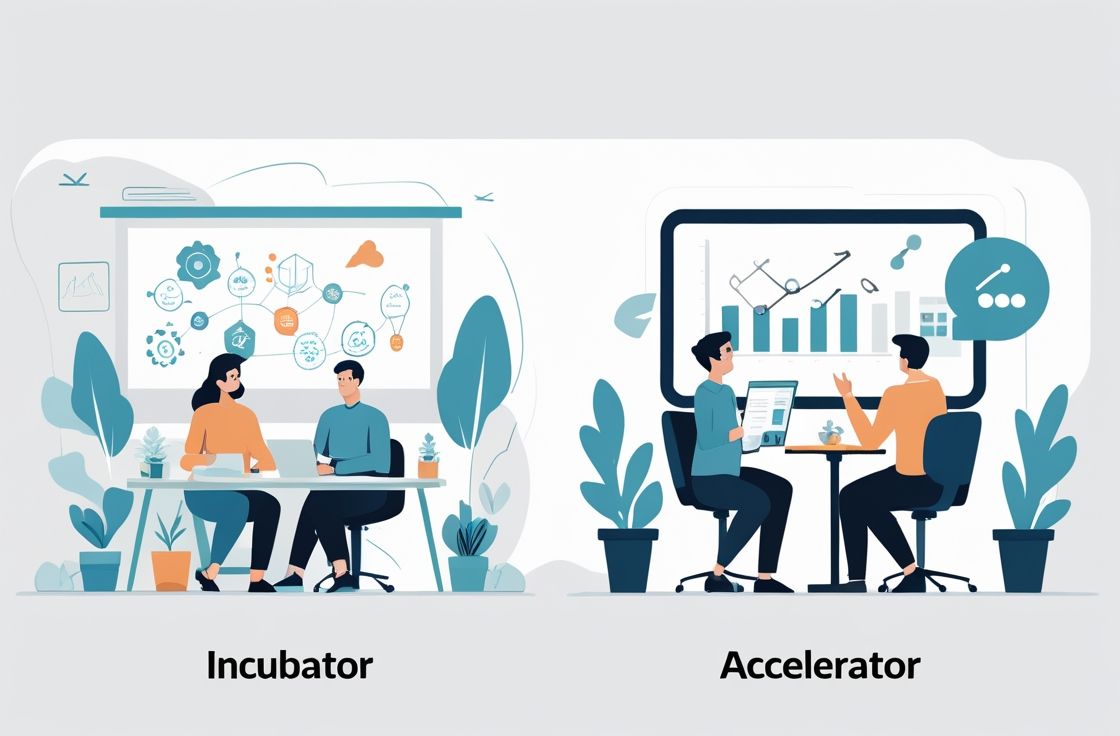
First introduced in the early 2000s as the startup ecosystem began to mature, incubators and accelerators have evolved from small-scale experiments into the foundation of modern entrepreneurship support.
Unlike traditional business mentoring, these programs provide more than advice. They offer structured environments where founders can access mentors, networks, capital, and resources, each with a distinct purpose and outcome.
The contrast becomes clear when considering the startup journey. An incubator may take years to nurture an idea into a viable business, while an accelerator compresses growth into a few months and prepares founders to secure funding and scale quickly.
This fundamental difference in startup Incubator vs accelerator makes it critical for entrepreneurs to understand which path aligns with their stage and goals.
Key Pointers
Startup incubators are designed for the earliest stages, providing time, space, mentorship, and business-building support.
Startup accelerators are structured, short-term programs that fuel growth for startups already in motion.
The key difference lies in stage and scope: incubators focus on nurturing ideas, while accelerators push for rapid growth and fundraising.
Both play crucial but different roles in the startup journey.
What is a startup incubator?
A startup incubator is a program built to help founders transform ideas into viable businesses. Incubators provide long-term support, often lasting 1–2 years, and focus on developing business models, refining prototypes, and connecting founders to resources.
Good incubators provide:
Access to shared workspaces
Ongoing mentorship
Basic business services (legal, accounting, HR)
A community of early-stage founders
Flexibility in timelines and outcomes
Incubators are ideal for entrepreneurs who are still validating their idea or experimenting with product-market fit.
Incubators are often backed by universities, government organizations, or nonprofit groups, though some are privately run. They generally do not invest directly in startups but may connect them to angel investors later on.
What is a startup accelerator?
A startup accelerator is designed for companies that are past the idea stage and ready to scale. Accelerators are short-term programs, usually 3–6 months, that offer equity funding, structured mentorship, and investor connections.
Good accelerators provide:
Initial seed funding in exchange for equity
Cohort-based programs with a fixed start and end date
Intensive mentorship from experienced founders and VCs
Investor exposure through demo days
Growth-oriented coaching in sales, fundraising, and scaling
Accelerators are best for startups that already have a working product, early traction, and the ambition to scale quickly.
Accelerators like Y Combinator, Techstars, and 500 Global have built reputations for helping startups achieve rapid scale and attract significant venture funding.
Key Differences Between Startup Incubators and Accelerators
1. Technology and Operating Model
Startup Incubators
Incubators focus on the earliest stage. They provide community support, workspace, and guidance but rarely offer direct funding or intense growth pressure. Most incubators are designed to help founders explore and validate ideas without strict deadlines.
Startup Accelerators
Accelerators are structured, time-bound programs. They provide funding, mentorship, and investor access with the goal of scaling quickly. Accelerators operate like growth sprints, compressing years of progress into a few months.
2. Capabilities and Functions
Startup Incubators
Help refine business models and validate concepts
Provide access to mentors, workshops, and shared resources
Offer community and collaboration opportunities
Best for founders still experimenting with product-market fit
Startup Accelerators
Provide seed funding in exchange for equity
Offer structured mentorship and growth playbooks
Connect startups directly with investors through demo days
Best for startups that already have traction and need rapid scaling
3. Founder Experience
Startup Incubators
Incubators emphasize learning and exploration. Founders receive advice and community support but must drive execution themselves. Progress is gradual, and success depends heavily on founder persistence and resourcefulness.
Startup Accelerators
Accelerators emphasize speed and accountability. Founders operate in a high-pressure environment with strict timelines, investor expectations, and demo day milestones. The experience is intense but often results in significant funding opportunities.
A Direct Comparison Between Startup Incubator vs Accelerator
While both incubators and accelerators aim to support startups, they differ in scope, stage, and structure. Here are the key differences:
| Factor | Incubator | Accelerator |
|---|---|---|
| Scope | Early-stage, idea-focused | Growth-stage, scale-focused |
| Timeline | Flexible, often 1–2 years | Fixed, 3–6 months |
| Funding | Usually no direct funding | Equity investment is common |
| Focus | Business model validation | Rapid growth and investor readiness |
| Entry Requirements | Idea or prototype | MVP or traction in the market |
| Outcome | Validated business model | Investor pitch and scaling support |
If you want to see how venture studios compare to incubators and which model may be a better fit for your startup, read our guide: Startup Incubator vs Venture Studio: Which Model is Right for You?
Who should choose an incubator?
Incubators are ideal if:
You only have an idea or early prototype
You lack a founding team with startup experience
You need time to explore product-market fit
You are looking for structured learning and community
You prefer low pressure over investor-driven growth
Who should choose an accelerator?
Accelerators are ideal if:
You already have an MVP or paying customers
You want to raise venture capital in the next 6–12 months
You thrive in a competitive, high-pressure environment
You are ready to give up equity for mentorship and funding
You need investor introductions to scale fast
Example: A SaaS startup with early ARR and a repeatable sales process would benefit from joining an accelerator like Y Combinator or Techstars.
Looking for programs beyond Y Combinator? Explore our guide: Top 10 Y Combinator Alternatives: Best Startup Accelerators in 2025.
The hidden trade-offs founders overlook
Many founders overlook the trade-offs when deciding:
Equity vs time: Accelerators often take 5–10% equity for a short program, while incubators may take no equity but require longer commitments.
Mentorship quality: Not all mentors are equal. Some programs overpromise but underdeliver.
Focus vs distraction: Incubators can lack urgency. Accelerators can push growth before product-market fit.
Funding pressure: Accelerator funding comes with expectations of rapid scale, which can misalign with your actual readiness.
Want to explore the leading startup studios shaping the future? Read our list: Top 10 Venture Studios in 2025 | Best Picks.
Build with Ellenox
Frequently Asked Questions
What is the main difference between an incubator and an accelerator? An incubator nurtures early-stage ideas, while an accelerator fast-tracks growth for startups with traction.
Do accelerators always take equity? Most accelerators take equity in exchange for funding and program access, though the percentage varies.
Which program is better for first-time founders? Incubators are often better suited for first-time founders still learning the fundamentals of building a business.
Can a startup join both an incubator and an accelerator? Yes. Many startups begin in an incubator and later apply to an accelerator once they are ready to scale.
How long do incubators and accelerators last?
Incubators can last 1–2 years, while accelerators usually run for 3–6 months.

Build with Ellenox
Building a successful startup is not about picking between an incubator or an accelerator. It is about proving your idea solves the right problem, knowing your users, and launching a product that can scale. Ellenox brings founders the advantage of research, product strategy, design, and development in one place. Every engagement is built around your goals, not program cycles. The focus is traction, fit, and building companies that last. For early founders who want more than mentorship or funding alone, Ellenox offers a path forward. If you are ready to move from idea to execution with precision, it is time to build with Ellenox.