


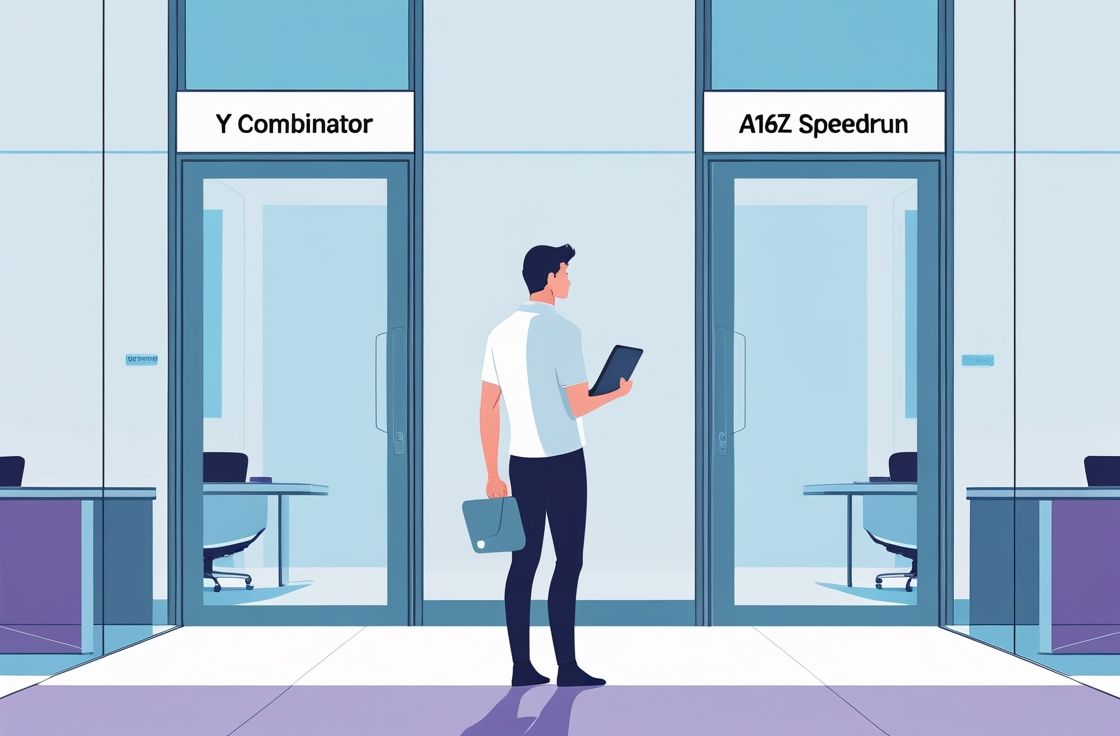
Choosing between Y Combinator and a16z Speedrun used to be a simple "prestige vs newcomer" question. It isn't anymore. Speedrun has run six cohorts, backed 250+ companies, deployed $300M+, and tightened its acceptance bar to below 0.4%, making it one of the hardest programs in the world to get into, YC included.
The better question was never which program is more prestigious. It's which program fits your stage, your thesis, and how much operational hand-holding you actually want.
This guide breaks down the real differences as of 2026: current deal terms, acceptance rates, and the honest tradeoffs between YC's scale and Speedrun's embedded, thesis-driven model.
Y Combinator vs a16z Speedrun: Quick Comparison
| Feature | Y Combinator | a16z Speedrun |
|---|---|---|
| Funding | $500K total: $125K for 7% + $375K uncapped MFN SAFE | Up to $1M: $500K for 10% upfront via SAFE + $500K follow-on within 18 months |
| Equity Structure | Fixed, standardized, non-negotiable | Fixed, standardized, non-negotiable (no longer case-by-case) |
| Program Length | 3 months | 12 weeks, in-person in San Francisco |
| Cohort Size | ~250 per batch | 60–70 teams per cohort |
| Acceptance Rate | ~1% (25,000+ applications per batch) | Below 0.4% (19,000+ applications, ~70 selected) |
| Mentorship | Partner-led office hours, self-directed | Embedded operating team: GTM, talent, brand, capital, legal |
| Focus Areas | Generalist | Broad tech-and-entertainment thesis: AI, consumer, media, software, XR |
| Location Requirement | Remote-friendly, historically Mountain View-centered | In-person attendance required in San Francisco |
| Alumni Network | 5,000+ startups | 600–1,000+ founders across 6 cohorts since 2023 |
| Notable Alumni | Airbnb, Stripe, Reddit, Dropbox | FLORA, Hedra, Runware |
1. Funding Terms and Equity
Y Combinator invests $500,000 in every accepted company, split into:
- $125,000 for a fixed 7% equity stake via a post-money SAFE
- $375,000 through an uncapped SAFE with a Most Favored Nation (MFN) clause, converting at your next priced round's terms
This deal has been unchanged since January 2022 and is identical across every batch. YC also now offers founders the option to receive their investment in USDC, a dollar-pegged stablecoin, alongside a traditional wire.
a16z Speedrun invests up to $1 million, structured as:
- $500,000 upfront for a fixed 10% equity stake via a SAFE at acceptance
- $500,000 follow-on invested within 18 months, on the same terms as your next lead investor
- Pro rata rights to maintain ownership through your Series A and B
This is a meaningful shift from Speedrun's earlier years: the deal used to be described as negotiated, typically landing in a 7–10% range. As of the SR006 and SR007 cohorts, it's now a fixed, standard deal with no negotiation, mirroring YC's own take-it-or-leave-it structure.
The key difference: Speedrun's total check is double YC's, but it comes with roughly 3 extra points of dilution and a structural catch: half the money doesn't arrive until you close your next round. YC hands over the full $500K immediately with no strings on timing. Founders who need capital in hand on day one should weigh that gap carefully.
2. Acceptance Rate and Application Process
Y Combinator receives more than 25,000 applications per batch and admits roughly 250 companies, an acceptance rate near 1%.
a16z Speedrun is now harder to get into than YC. The SR006 cohort drew over 19,000 applications for roughly 70 spots, an acceptance rate below 0.4%. Speedrun's application process centers on five core questions rather than YC's format, and reviewers are explicitly evaluating founder speed and a distinct insight, not just idea quality. A common mistake founders make is treating a Speedrun application like a smaller YC application; the two panels are looking for genuinely different signals, and Speedrun's tech-and-entertainment thesis rewards founders who understand that going in.
3. Mentorship and Support Structure
Y Combinator gives founders autonomy. Weekly partner office hours, founder dinners, and access to Bookface make up the core support structure. It's a self-directed environment: founders get exposure and pattern recognition, but day-to-day execution is on them.
Speedrun embeds founders directly into a16z's operating network. Accepted teams get dedicated support across talent and recruiting, go-to-market, brand, HR, capital networks, and even visa support through Speedrun's Global Founders Program. There's no fixed curriculum; support flows to whatever gap a specific team has, delivered by a stacked team of operators rather than a handful of partners spread across hundreds of companies.
Takeaway: YC trades depth of support for scale and network breadth. Speedrun trades program size for a much higher ratio of operator attention per founder, an advantage that scales with how well your company fits a16z's specific tech-and-entertainment thesis.
Not Ready for the Accelerator Path?
Most founders apply to an accelerator before the underlying product or traction can actually carry the program. If you're still shaping your MVP, validating demand, or figuring out your go-to-market, Ellenox helps build that foundation first, so an accelerator application reflects real signal instead of hope.
4. Program Design and Duration
| Feature | Y Combinator | a16z Speedrun |
|---|---|---|
| Length | 3 months | 12 weeks |
| Structure | Weekly touchpoints, partner office hours | Sequential modules: product, GTM, fundraising, team building, scaling |
| Location | Remote-friendly | In-person required, San Francisco |
| Demo Day | Yes, public, 1,000+ investors | Yes, curated investor audience |
Speedrun's structure has firmed up considerably since its early cohorts. It now runs on defined sequential modules rather than loose, on-demand sessions, and in-person attendance in San Francisco is a hard requirement, not a preference. YC remains the more flexible option for founders who can't relocate.
5. Alumni Network and Fundraising Outcomes
| Metric | Y Combinator | a16z Speedrun (through SR007) |
|---|---|---|
| Companies Funded | 5,000+ | 250+ |
| Capital Invested | Reflected in $600B+ valuation | $300M+ deployed |
| Unicorns | 90+ | None publicly disclosed yet |
| Alumni Community | 5,000+ startups | 600–1,000+ founders |
| Notable Alumni | Airbnb, Stripe, Dropbox, Reddit | FLORA, Hedra, Runware |
YC's alumni base spans two decades and includes some of the largest tech companies ever built. Speedrun's outcomes are still young by comparison, three years in, but its growth trajectory is fast: from roughly 100 companies across its first four cohorts to 250+ by its sixth, with nearly 10,000 investors reportedly engaging with companies from its most recent batch.
6. Global Reach and Program Access
Y Combinator is headquartered in Mountain View and has run remote-friendly batches since 2020, making it more accessible to founders who can't relocate to the Bay Area.
a16z Speedrun requires in-person attendance in San Francisco for the full 12 weeks, though it explicitly welcomes founders from anywhere in the world and offers visa and relocation support through its Global Founders Program. If relocating for three months is a genuine barrier, that's a real constraint on Speedrun, not a minor inconvenience.
7. Which Program Fits Your Thesis and Stage
Building in AI, consumer, media, XR, or software with a tech-and-entertainment angle: Speedrun's thesis is broad but specific. If your company sits squarely inside it, the operator-level support and $1M check can compress your timeline faster than YC's more generalist environment.
Building outside that thesis, or in a category YC handles well (enterprise SaaS, fintech, dev tools): YC's generalist model and much larger alumni base give you a wider peer group and a more universally recognized signal to investors outside a16z's specific network.
Need capital in hand immediately: YC's full $500K lands upfront. Speedrun's structure holds back half the check until your next round closes, which matters if your runway math depends on having the full amount now.
Can't relocate for three months: YC remains the more flexible choice. Speedrun's in-person requirement in San Francisco is non-negotiable.
8. Demo Day and Post-Program Support
YC's Demo Day is a large, public event reaching over 1,000 investors, frequently producing fast follow-on raises in the days immediately after.
Speedrun's Demo Day is smaller and more curated, built around investors already aligned with each startup's specific market, with nearly 10,000 investors engaging across the program's portfolio in its most recent cohort. Post-program, Speedrun graduates keep access to the alumni network and ongoing platform support, plus a16z's broader capital network for follow-on rounds.
Final Take: Should You Pick YC, Speedrun, or Ellenox?
Choose Y Combinator if:
- You want the broadest possible investor signal and a generalist environment
- You need the full check available immediately, with no follow-on conditions
- You can't commit to relocating for a full program cycle
Choose a16z Speedrun if:
- Your company fits squarely inside a16z's tech-and-entertainment thesis
- You want embedded, operator-level support rather than office-hours access
- You can relocate to San Francisco and commit fully to an in-person program
Ready to Build Something Real?
Most founders apply to accelerators before the idea, product, or traction is ready to make the most of the program. If you're still validating demand, shaping your MVP, or refining go-to-market, Ellenox works alongside early-stage teams to build that foundation first, so whichever path you choose next, YC, Speedrun, or continuing to build independently, you're walking in with real signal instead of a pitch.